Mechanical rebar splicing is a practical way to connect reinforcement bars without using long overlapping lap lengths. A rebar coupler connects adjoining bars directly and can help reduce reinforcement congestion, steel overlap, cutting, bending and handling work.
This method is useful in high-rise buildings, RCC structures, bridges, foundations, piling, tunnels, industrial projects and power infrastructure where reinforcement space and construction efficiency are important.
Surya Engineering manufactures and supplies different mechanical rebar splicing systems, including cold forged, parallel threaded, taper threaded, bar break, piling and one-touch couplers. The suitable system depends on the rebar diameter, steel grade, structural requirements and site conditions.
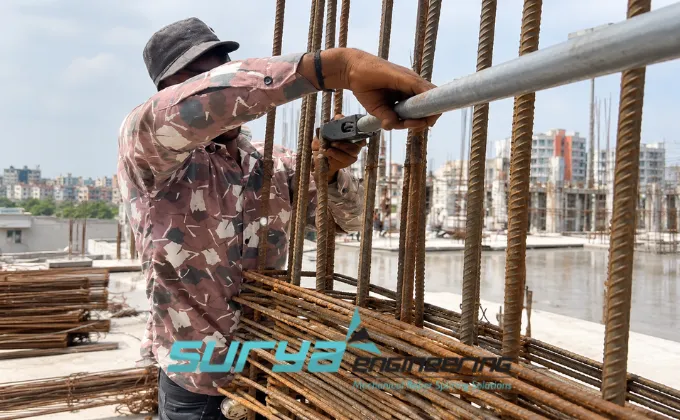
Mechanical rebar splicing connects two reinforcement bars using a mechanical coupler, while conventional lap splicing connects bars by overlapping them over a specified length.
The difference can be understood simply:
Rebar couplers can be particularly useful where reinforcement is heavily congested or where there is not enough space to provide long lap lengths.
The selected coupler connects adjoining reinforcement bars according to the required mechanical connection method. The exact preparation depends on the type of coupler being used.
Before selecting a system, the project should consider:
The selected coupler should be designed and approved for the particular reinforcement bar and project requirements.
For projects looking at different connection systems, Surya Engineering's range of rebar coupler solutions provides a reference to the available mechanical splicing options.
Rebar couplers provide a practical alternative to traditional lap splicing, particularly where reinforcement is heavily congested or available space is limited.
The main advantages include:
These benefits do not mean that couplers provide the same result or saving on every project. The actual suitability depends on the reinforcement design, project requirements and installation conditions.
Mechanical rebar splicing can be particularly useful in areas where long lap lengths are difficult to accommodate or reinforcement is already heavily congested.
Typical situations include:
By removing long overlapping sections, a mechanical connection can create a more compact reinforcement arrangement and provide more available space for reinforcement fixing and concrete placement.
Rebar couplers are available in different sizes, grades and configurations for different reinforcement connection requirements.
The appropriate system depends on the reinforcement diameter, steel grade, bar arrangement and project specification.
Different coupler configurations are used for different reinforcement conditions.
The main types include:
Surya Engineering supplies several options, including cold forged rebar couplers and parallel threaded rebar couplers.
The choice depends on the rebar diameter, steel grade, structural requirements and site conditions.
Rebar couplers are available for common reinforcement diameters used in construction, typically ranging from 12 mm to 40 mm.
Common sizes include:
Couplers are compatible with standard reinforcement steel grades, including Fe 415, Fe 500, Fe 500D, Fe 550 and Fe 550D.
The selected coupler system should match the rebar diameter, steel grade and project specification.
Surya Engineering manufactures and supplies mechanical rebar splicing systems for different structural and construction requirements.
The supplied range includes:
These couplers are available in different sizes and configurations for reinforcement diameters from 12 mm to 40 mm.
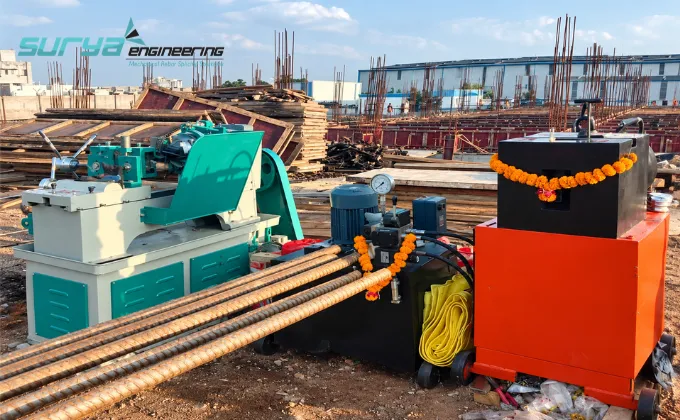
Where a project requires a quick mechanical connection option, the one-touch rebar connection system is another product within Surya Engineering's range.
The final coupler selection should be based on rebar diameter, steel grade, structural requirements and site conditions.
Testing and quality verification are important when selecting a mechanical rebar splicing system.
The exact acceptance requirements can vary according to the coupler type, rebar diameter, steel grade and project specification. Surya Engineering carries out manufacturing and quality checks and can provide relevant technical specifications and quality documentation for selected couplers.
Depending on the product and application, Surya Engineering's rebar couplers are designed in accordance with relevant:
Surya Engineering is ISO 9001 certified and carries out quality checks during manufacturing and before products are dispatched.
The applicable standard should be checked against the selected coupler and the requirements of the individual project.
Testing requirements depend on the product and project.
Typical quality verification may include:
For specific project approvals, additional testing may be required depending on the project specification.
At the Rivali Park project, the testing programme included tensile, low-cycle, fatigue and slip tests at an NABL-accredited laboratory.
The Rivali Park project provides a detailed example of how a mechanical rebar splicing system was evaluated before final approval.
The approval process included:
Representatives of Jain Engineers, the client team and Surya Engineering witnessed the testing process.
The complete laboratory reports were submitted for technical review, and the project order was awarded after the reports were received, reviewed and accepted.
The Rivali Park project case study provides the detailed first-party project record behind this testing and approval process.
Mechanical rebar splicing can be used across construction and infrastructure projects where reinforcement bars need to be connected.
The supplied applications include high-rise buildings, bridges, foundations, tunnels, industrial structures and power infrastructure.
High-rise RCC construction can involve heavily reinforced columns, shear walls, beam-column junctions and other congested areas.
With conventional lapping, reinforcement bars overlap over a specified length. This can increase the amount of steel within the same structural section and make reinforcement fixing and concrete placement more difficult.
Mechanical couplers provide a direct end-to-end connection. By removing the overlapping lap length, they can help create a more manageable reinforcement arrangement.
The Rivali Park project in Borivali, Mumbai provides a first-party example of mechanical rebar splicing being used in a 60-floor high-rise building with a G+5+55 configuration.
Yes. Surya Engineering's supplied applications include several infrastructure and foundation projects.
These include:
The appropriate coupler depends on the rebar diameter, steel grade, structural requirements and site conditions.
Mechanical splicing can be particularly useful where long lap lengths are difficult to accommodate or reinforcement congestion needs to be managed.
The supplied applications also include:
These projects can involve large reinforcement quantities and areas where reinforcement arrangement, space and installation efficiency are important.
Surya Engineering has also received customer feedback regarding the use of its MBT and rebar couplers at Rivali Park, Borivali, Mumbai, with the customer highlighting product quality and durability.
The most suitable connection system should be selected according to the specific reinforcement and project conditions.
Rivali Park in Borivali, Mumbai provides a detailed project example of mechanical rebar splicing being selected instead of conventional reinforcement lapping.
Surya Engineering supplied rebar couplers and provided technical and machinery support for one 60-floor high-rise building with a G+5+55 configuration. The project was executed under CCI, while Jain Engineers was the RCC contractor.
The project initially planned to use conventional reinforcement lapping.
After studying the technical, operational and commercial implications, the project consultant recommended converting the reinforcement connection system from conventional lapping to mechanical rebar couplers.
A detailed comparison initially indicated an estimated saving of approximately ₹2.50 crore.
After the actual RCC execution and final cost comparison, the builder reported an approximate net saving of ₹2.30 crore through the use of rebar couplers instead of conventional reinforcement lapping.
The reported saving was associated with several project-specific factors:
This ₹2.30 crore figure is a reported result from the Rivali Park project, not a guaranteed saving for every rebar coupler application.
Jain Engineers, as the RCC contractor, coordinated the reinforcement work and daily site requirements with the project team and Surya Engineering.
This coordination helped ensure that forged and threaded reinforcement bars were prepared according to the construction requirements and planned slab cycle.
The 60-floor building used Mivan aluminium formwork technology.
The project team planned an accelerated construction programme with a target of approximately three slabs per month. The combination of Mivan formwork and mechanical rebar couplers supported this demanding construction schedule.
Under conventional lapping, reinforcement bars may need to be measured, cut and adjusted according to the required lap length. Additional bending, shifting and site-level adjustments can also be required.
The coupler-based system simplified this preparation by allowing reinforcement bars to be systematically prepared and connected at the required structural location.
With proper planning and execution, the RCC structure of the 60-floor high-rise building was completed in approximately 24 months.
Traditional reinforcement lapping can require several labour-intensive activities before bars reach their final installation location.
These can include:
The Rivali Park project reported reductions in these activities through the use of mechanical rebar couplers.
The simplified preparation and connection process helped improve site productivity and allowed the contractor to use its workforce more effectively.
The approval process included witnessed testing at an NABL-accredited laboratory.
The testing programme evaluated:
The project order was awarded to Surya Engineering after the client received, reviewed and accepted the complete laboratory test reports.
The project team's post-execution assessment reported an approximate ₹2.30 crore saving compared with the originally planned conventional lapping system.
Additional reported project benefits included:
The project also demonstrated the importance of combining tested couplers with dedicated machinery, production planning, technical support and coordination between the coupler supplier and RCC contractor.
For this project, the reported result was achieved through the specific combination of mechanical splicing, machinery, site planning, testing and execution support. It should therefore be considered a project-specific result rather than a universal performance or cost-saving guarantee.
Surya Engineering manufactures rebar couplers and mechanical rebar splicing solutions for high-rise buildings, infrastructure projects, industrial developments and RCC construction applications.
The project support can include:
Surya Engineering works with builders, RCC contractors, infrastructure companies, consultants and construction professionals to develop a rebar splicing system according to project requirements, reinforcement sizes, production targets and construction timelines.
The Rivali Park project also demonstrates that the role of a mechanical rebar splicing supplier can extend beyond product supply to include factory evaluation, laboratory testing, technical approval, machinery deployment and site execution support.
For projects considering mechanical rebar splicing, the selection should be based on the actual rebar diameter, steel grade, structural requirements, applicable standards, site conditions and required production schedule.
Mechanical rebar couplers can provide an alternative to conventional lapping where reinforcement congestion, long lap lengths, material utilization and construction productivity are important considerations.
Contact SURYA Engineering for expert guidance on selecting the right coupler system, NABL test certificates, and on-site machinery support.
Get in Touch