
Precision-engineered mechanical splice for reinforcement bars. Achieve 100% tensile strength, reduce steel waste, and accelerate construction — available in 12mm to 40mm sizes.
Get Project Price →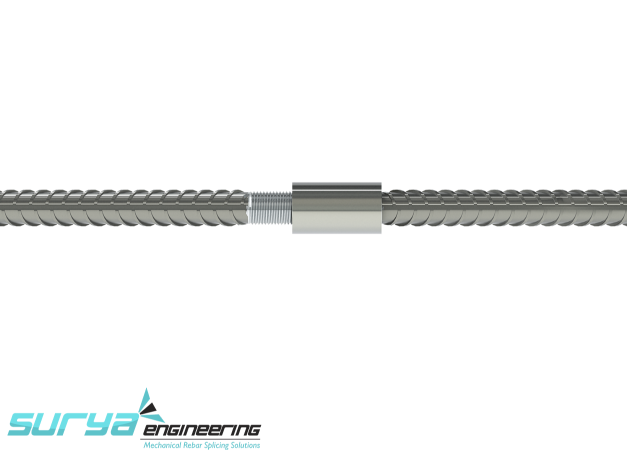
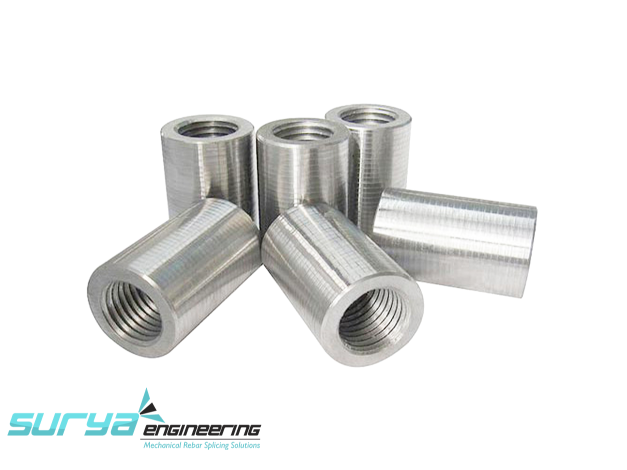
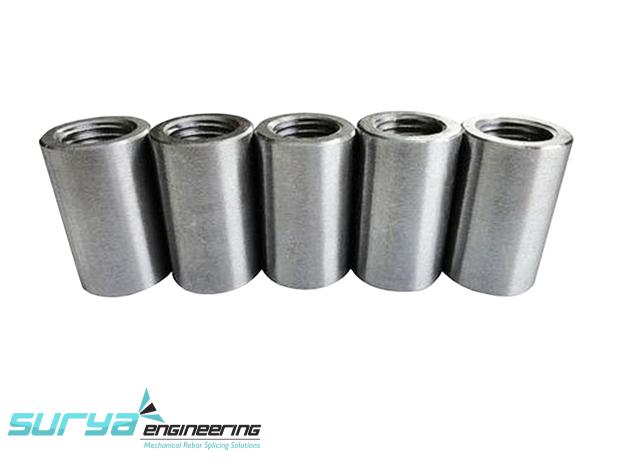
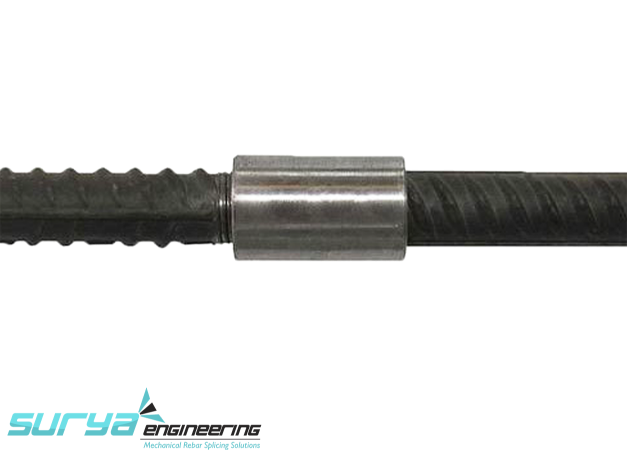
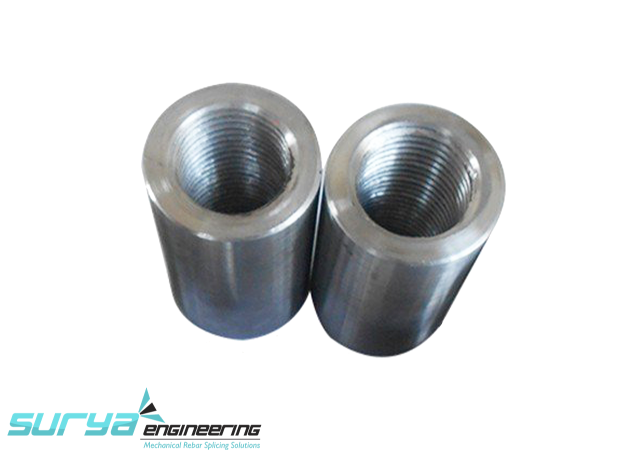
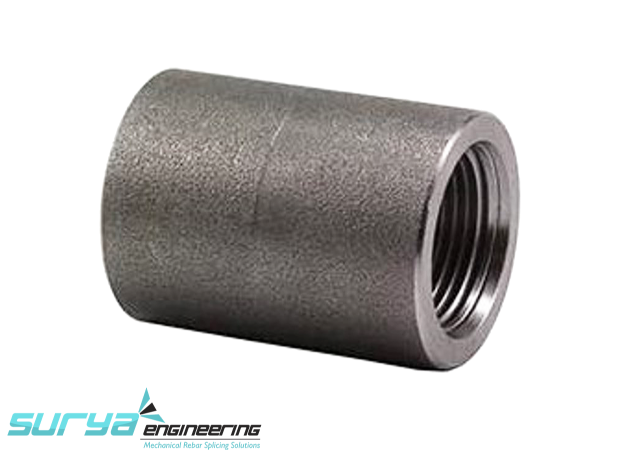
A Parallel Threaded Rebar Coupler is a cylindrical steel connector internally machined with precision parallel threads. Reinforcement bars are threaded using a roller threading or threading machine so that their external threads match the internal threads of the coupler.
When the bars are inserted and tightened, the coupler forms a secure mechanical joint that enables direct axial load transfer — without welding, chemicals, or grout.
Because of its reliability and efficiency, the Parallel Threaded Rebar Coupler is widely used in RCC construction where structural integrity and long-term durability are priorities.
In high-rise buildings, infrastructure projects, bridges, metro systems, and industrial construction, threaded rebar couplers are increasingly preferred because they deliver consistent structural performance while improving construction efficiency.
By eliminating unnecessary lap lengths and reducing reinforcement crowding, they enhance concrete flow and simplify quality inspection. For contractors and project managers, this translates into measurable cost savings and improved execution timelines.
In conventional lap splicing, reinforcement bars overlap for a specified length to transfer load through bonding with concrete. While effective in certain applications, this approach increases steel consumption and leads to congestion in beams, columns, and shear walls. A Parallel Threaded Rebar Coupler eliminates the need for extended overlap by forming a compact mechanical splice.
| Parameter | Lap Splicing | Parallel Threaded Rebar Coupler |
|---|---|---|
| Steel Consumption | Increased due to overlap | Optimized without extra lap length |
| Reinforcement Congestion | High in dense areas | Significantly reduced |
| Load Transfer | Through concrete bond | Direct mechanical engagement |
| Installation Speed | Slower and labor-intensive | Faster and controlled |
| Concrete Flow | May be restricted | Improved due to slim joint |
| Inspection & Quality Control | Limited verification | Easy mechanical inspection |
By reducing steel wastage and improving structural consistency, threaded couplers offer both technical and economic advantages in modern construction.
The functioning is based on precise thread engagement between the coupler and the reinforcement bars. The absence of welding, chemical bonding, or grout simplifies installation and enhances safety at the construction site.
Different configurations are available to accommodate various structural conditions and reinforcement layouts. This flexibility ensures adaptability across complex structural requirements.
| Type | Description |
|---|---|
| Standard Coupler | Used when both bars can rotate freely during installation |
| Position Coupler | Suitable where one or both bars cannot rotate |
| Reducer Coupler | Designed to join bars of different diameters |
| Transition Coupler | Used to connect different bar grades or specifications |
Manufactured in a wide range of diameters to suit residential, commercial, and heavy infrastructure projects. Compatible with Fe500, Fe550, and Fe500D reinforcement bars.
Parallel Threaded Rebar Couplers are widely used across residential, commercial, and heavy infrastructure projects. Their ability to ensure full tensile strength transfer makes them particularly valuable in high-load applications where structural reliability is critical.
To ensure structural reliability, threaded couplers undergo performance testing procedures designed to verify strength and durability, confirming consistent performance in demanding structural environments.
| Test | Purpose |
|---|---|
| Static Tensile Test | Ensures failure occurs in parent bar rather than joint |
| Slip Test | Measures movement between rebar and coupler under load |
| 100 Cycle Test | Evaluates durability under repeated loading conditions |
| Fatigue Testing | Assesses endurance under cyclic stress conditions |
At Surya Engineering, we ensure the highest precision and dimensional accuracy by performing stringent quality control procedures on every Parallel Threaded Rebar Coupler we manufacture.
A critical dimensional inspection used to verify internal thread accuracy of the coupler. A specially designed gauge with two ends ensures every coupler meets precise specifications.
Go End — must fit smoothly into the coupler, confirming internal threads are within the specified tolerance range.
No‑Go End — must not enter the coupler, ensuring it is not oversized beyond defined limits.
Each coupler is marked with a unique identification code enabling end-to-end traceability across the entire supply chain — from raw material to final delivery.
| Benefit | Explanation |
|---|---|
| Traceability | Track each coupler from raw material to delivery |
| Quality Assurance | Strict quality norms across manufacturing |
| Accountability | Consistency and responsibility at every stage |
Available in 12mm–40mm | Fe500, Fe550, Fe500D Compatible | Pan-India Supply
Get a Quote →