
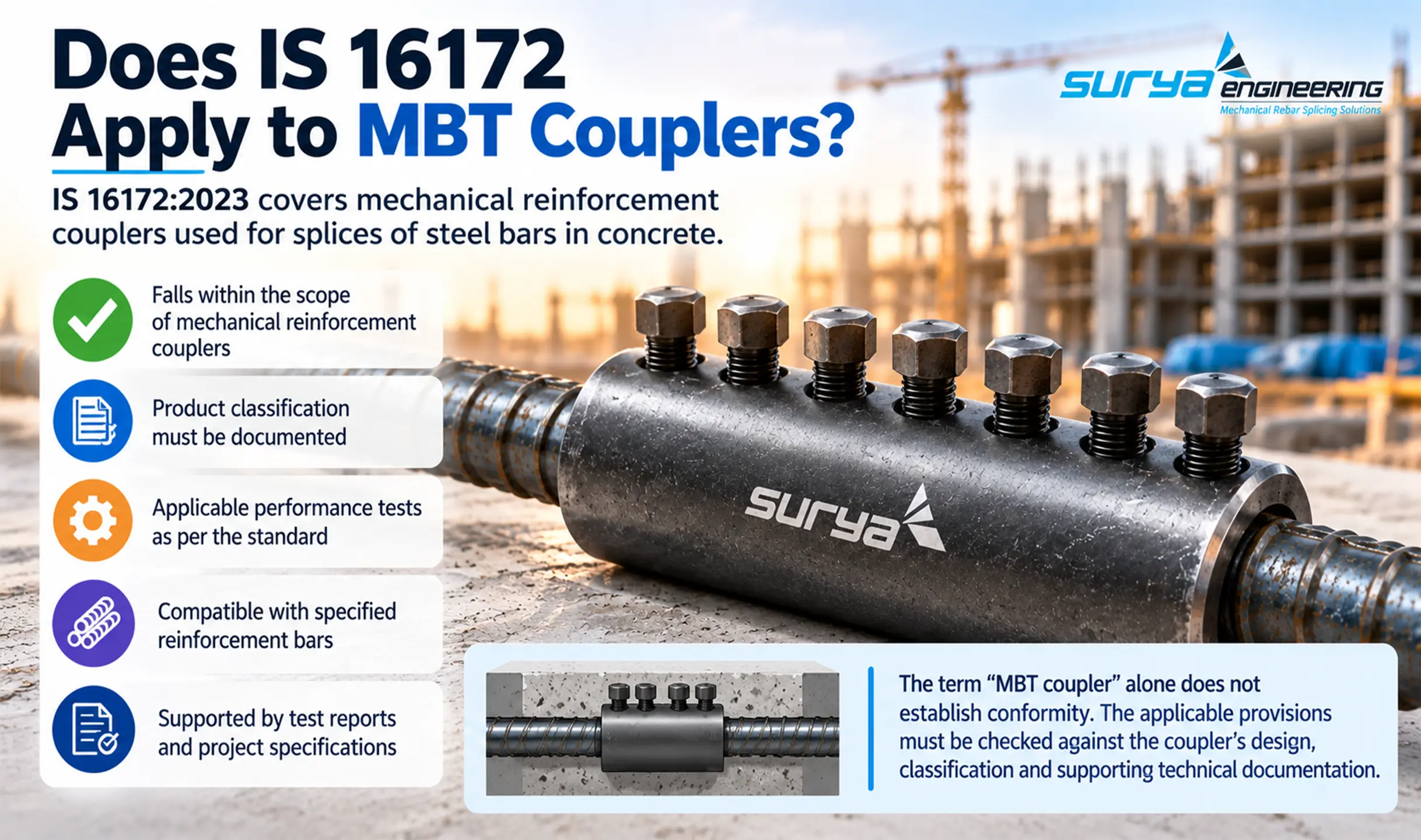
The relevant Indian Standard for mechanical reinforcement couplers is IS 16172:2023, Reinforcement Couplers for Mechanical Splices of Steel Bars in Concrete – Specification (First Revision). It provides a framework for evaluating mechanical splices used to connect reinforcing steel bars in concrete structures.
An MBT coupler is a mechanical connection used to join reinforcing bars without relying on a conventional lap splice. Its suitability depends on the coupler design, compatible reinforcement, installation procedure and applicable performance requirements.
When checking an MBT coupler against IS 16172, the important points are:
For product details, refer to Surya Engineering's MBT Coupler page.
Configure your project structural parameters to evaluate mechanical coupler class requirements, standard revision conformity, and connection mechanism.
Verify whether supplier documentation adequately establishes product conformity, distinguishing standalone lab test reports from valid BIS licences.
Review supplier documents. Test reports alone do not prove BIS certification validity.
| Document Type | What it Establishes | Key Verification Checks |
|---|---|---|
| BIS Certification Licence | Official BIS authorization to use ISI mark under IS 16172. | Check licence validity on BIS portal; verify exact rebar size scope. |
| Independent Lab Test Report | Physical tensile, slip, and elongation performance on batch samples. | Verify IS 16172:2023 edition reference and failure location in bar. |
| Technical Datasheet | Declared product dimensions, bolt torque specs & installation limits. | Confirm compatibility with site rebar grade (e.g. Fe 500D). |
Calculate steel tonnage saved and net financial advantages of replacing traditional overlap splices (50d lap length as per IS 456) with mechanical rebar couplers.
Direct reduction in steel consumption by eliminating 50d lap overlap.
Value of lap overlap steel eliminated from procurement bill.
Steel savings minus total coupler procurement cost.
Quality assurance field standard for shear-bolt mechanical rebar splices under IS 16172 guidance.
Generate a structured technical enquiry to send to Surya Engineering with your exact project parameters and IS 16172 requirements.
IS 16172:2023 covers reinforcement couplers used for mechanical splices of steel bars in concrete. It establishes technical provisions for assessing the performance of these connections.
The standard is relevant when checking whether a mechanical coupler is suitable for a specified reinforcement application. However, a product's suitability cannot be established from the standard number alone. The particular design, classification and supporting technical documentation must also be considered.
When reviewing a coupler against IS 16172:2023, check:
Yes. IS 16172:2023 is the first revision of IS 16172:2014. The edition referenced in technical documents matters because requirements and evaluation criteria must be checked against the applicable version.
When reviewing an older test report or technical specification, verify:
An older report should not automatically be treated as evidence of compliance with a revised edition. Its validity for the intended application must be established from the relevant technical and project requirements.
The standard concerns mechanical reinforcement couplers, but the term “MBT coupler” alone does not establish a product's classification or demonstrate conformity.
The applicable provisions must be checked against the coupler's construction and operating principle. The product documentation should establish how the specific design is classified and which requirements apply.
Before accepting an MBT coupler for a project, confirm that:
Mechanical reinforcement couplers can use different connection mechanisms. The applicable standard documentation may address categories such as:
These categories describe different approaches to connecting reinforcement bars. They should not be treated as interchangeable, because their connection mechanisms, installation procedures and verification requirements can differ.
The classification of a particular MBT coupler must be established from its technical documentation rather than inferred from the product name.
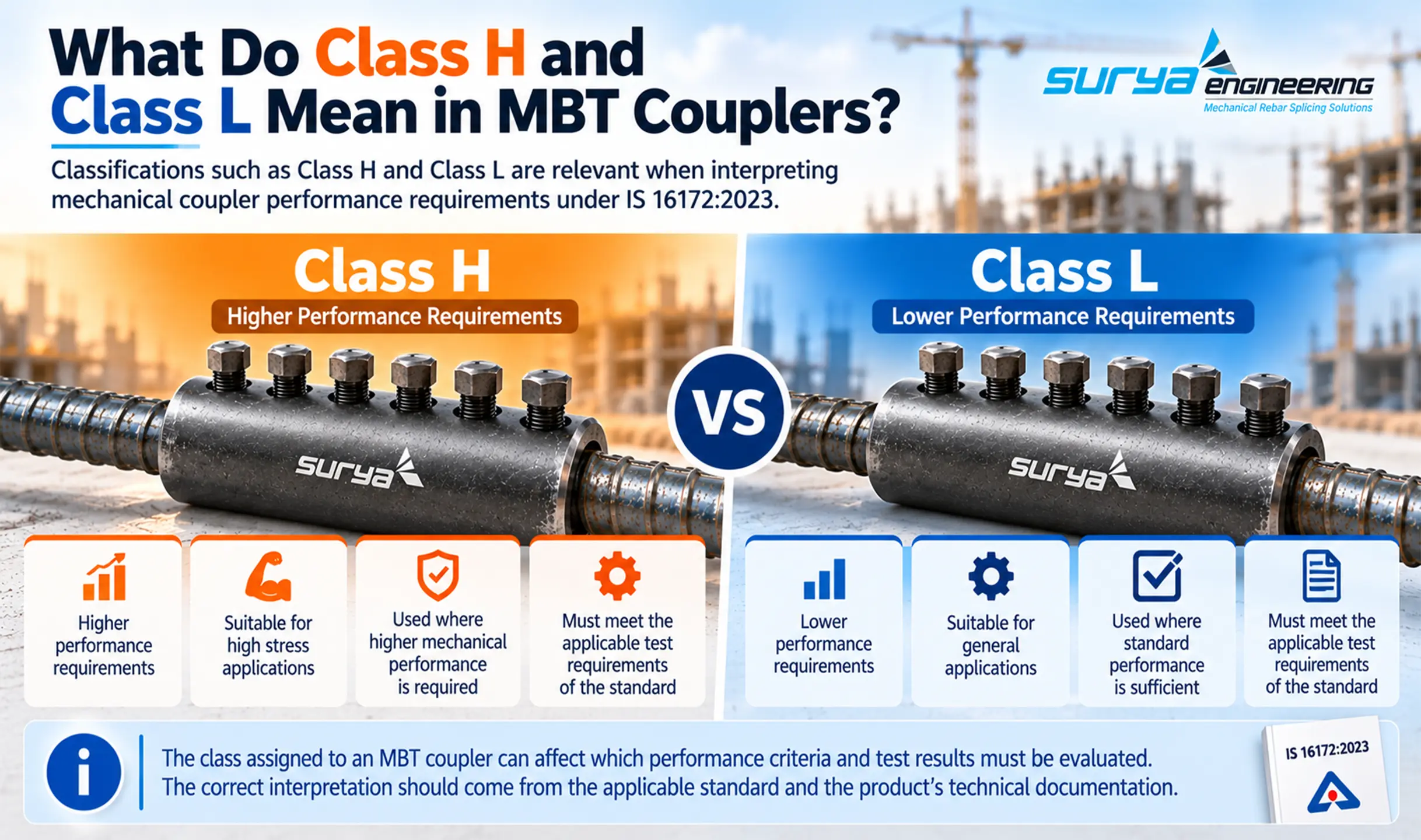
Classifications such as Class H and Class L are relevant when interpreting mechanical coupler performance requirements under the applicable standard.
The class assigned to a product can affect which performance criteria and test results must be evaluated. The correct interpretation should come from the applicable standard and the product's supporting documents.
When checking a declared classification, verify:
Do not assume that every MBT coupler belongs to the same class or that a classification can be confirmed without supporting evidence.
Check Class H vs Class L Criteria in ToolThe main difference is the connection mechanism used to join the reinforcing bars.
A conventional threaded coupler connects bars through compatible threads formed on their ends. Other mechanical coupler designs may use different gripping or locking arrangements, depending on the product.
The distinction matters because the installation procedure and compatibility checks depend on the actual design.
For an MBT coupler, establish the following from the manufacturer's instructions:
These details should be confirmed for the specific model rather than generalized across all mechanical couplers.
The applicable testing requirements depend on the standard provisions, coupler classification, design and intended use. Relevant evaluations can include tensile strength, elongation, slip, cyclic tensile loading and fatigue, where applicable.
A tensile test evaluates the performance of a mechanical splice when the connected reinforcement assembly is subjected to tension.
The test helps establish whether the connection meets the applicable strength criteria. The acceptance requirements must be taken from the relevant standard provisions and product classification.
When reviewing a tensile test report, check:
The report should relate to the product being evaluated, not merely to a broadly similar coupler.
Slip and elongation provide different information about the behaviour of a mechanical splice.
These results help assess connection behaviour beyond a simple statement that the coupler has been tested.
When comparing reports, check that the test method, sample configuration and acceptance criteria are appropriate for the product and application.
Cyclic tensile loading and fatigue testing may be relevant where required by the applicable provisions or project specification.
Not every test necessarily applies to every coupler configuration. The required test programme and acceptance limits should be verified against the applicable standard, classification and project documentation.
Run Test Report & BIS Audit WizardThe existence of an Indian Standard does not, by itself, establish that BIS certification is mandatory for every product covered by that standard.
The applicable certification status must be verified against current BIS requirements, relevant government notifications or quality control orders, and project specifications. Certification requirements can change, so they should be checked at the time of procurement.
Before relying on a certification claim, confirm:
Avoid treating the words “IS 16172 compliant” and “BIS certified” as interchangeable.
A test report and a BIS licence serve different purposes.
| Document | What it establishes | What to verify |
|---|---|---|
| Test report | Records the results of specified tests on submitted samples | Product identification, test methods, results and acceptance criteria |
| BIS licence | Establishes authorization under the applicable BIS certification scheme | Licence validity, standard, scope and covered product |
| Manufacturer's technical datasheet | Provides declared product specifications and usage information | Bar compatibility, dimensions, installation procedure and limitations |
| Project approval document | Records acceptance under a project's specified review process | Approved product, revision and applicable project requirements |
A test report does not automatically prove that a manufacturer holds a valid BIS licence. Similarly, a licence claim should be checked against the applicable product scope rather than accepted from a logo or statement alone.
Use the official BIS resources to check the current status of a certification claim, where applicable.
A practical verification process is:
If the product documentation does not establish the certification status, request clarification before describing the product as BIS certified.
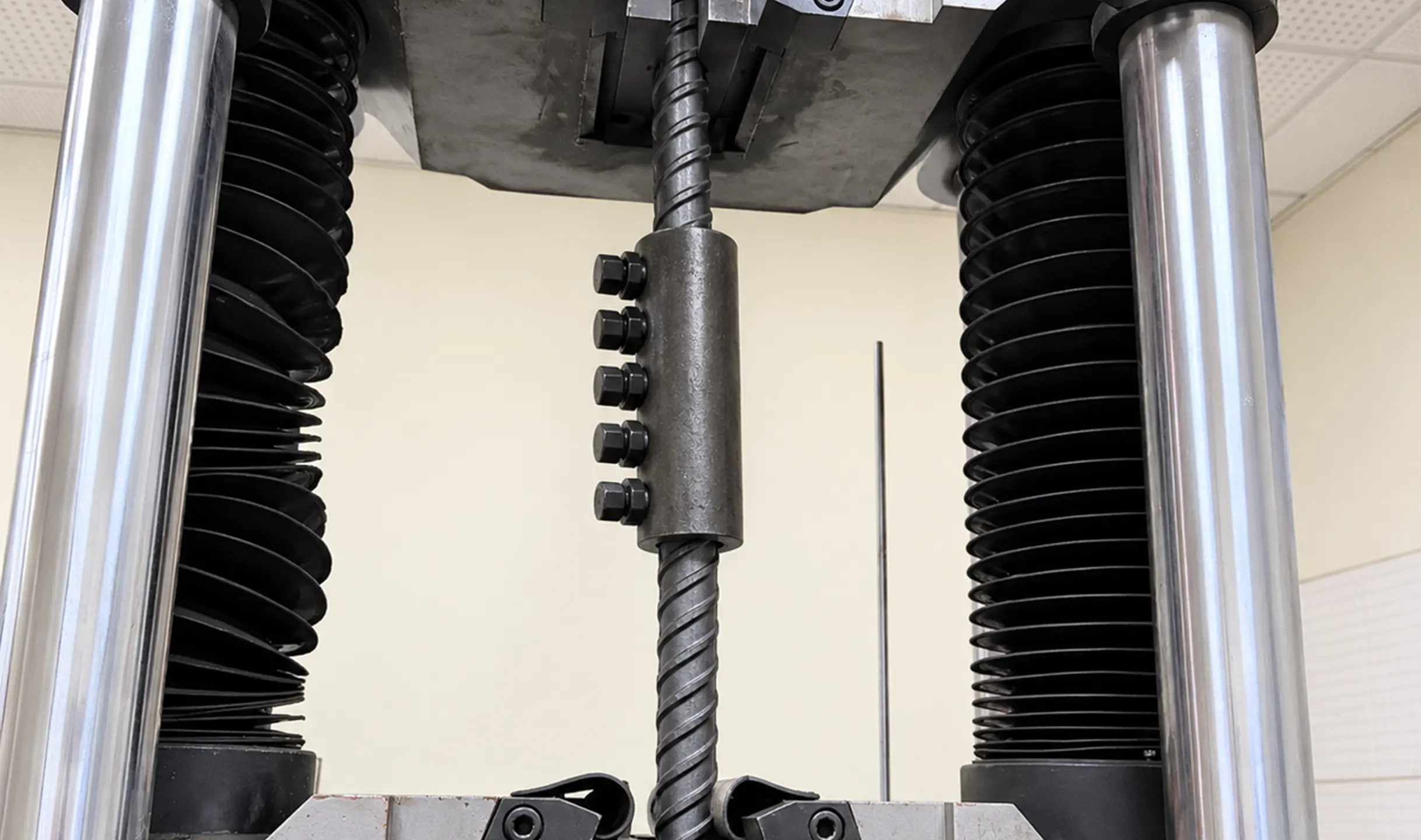
The coupler must be suitable for the reinforcement specified in the structural design. Compatibility should be confirmed using the manufacturer's technical documentation.
Check the following before selecting a model:
Do not assume that a coupler suitable for one bar diameter or grade is automatically suitable for another. The actual compatibility range must be supported by product documentation.
Calculate Steel Savings for Your Bar DiameterTechnical documentation helps establish whether the coupler is appropriate for the intended use and whether its performance claims are supported.
Depending on the project and applicable requirements, relevant documents may include:
Check that the documents identify the correct product and configuration. A report for a different model, bar size or test arrangement may not establish the performance of the coupler under review.
Installation must follow the manufacturer's instructions for the specific coupler design. A generic installation procedure should not replace the approved product instructions.
Use this checklist to organize the installation review:
The exact installation steps depend on the coupler mechanism. Do not apply threaded-coupler procedures to an MBT design unless the manufacturer's instructions specifically require them.
View & Print Field QA/QC ChecklistThe correct selection starts with the structural specification and the coupler's documented performance, not just its product name.
Use this checklist when evaluating a product:
These checks help establish whether the product's documented capabilities match the requirements of the intended structure.
Providing the relevant project details helps the supplier identify a suitable product and clarify its compatibility.
Include the following information in your enquiry:
If the project has an approved coupler specification or drawing, include it with the enquiry. This reduces ambiguity when confirming the correct product configuration.
Surya Engineering provides product information for its MBT couplers through its website. To review the available product details, visit the MBT Coupler product page.
For a product enquiry, provide the required bar size, reinforcement grade, intended use and applicable project specification. Ask for the relevant technical datasheet, installation instructions and supporting test documentation for the specific model.
Confirm product availability, compatibility and any certification claims directly with the company before finalizing a project specification.
IS 16172 is the Indian Standard for reinforcement couplers used for mechanical splices of steel bars in concrete. IS 16172:2023 is the first revision of IS 16172:2014. The applicable provisions for a particular MBT coupler depend on its design and classification.
IS 16172:2023 is the first revision of IS 16172:2014. For a current project, verify the applicable edition through official standards information and check the edition specified in the project documents.
Not necessarily. The requirement depends on the particular coupler design. Confirm the bar preparation and connection method in the manufacturer's instructions for the exact MBT model.
No. A test report records the results of specified tests, while a BIS licence establishes authorization under the relevant certification scheme. Verify any certification claim separately through official BIS records, where applicable.
Relevant evaluations can include tensile strength, elongation, slip, cyclic tensile loading and fatigue, as applicable. The required tests and acceptance criteria depend on the applicable standard provisions, coupler classification and project specification.
You can review the product details on Surya Engineering's MBT Coupler page. For project-specific selection, request the technical datasheet, installation instructions and relevant supporting test documentation.
Contact Surya Engineering for technical datasheets, certified NABL laboratory test reports, BIS licence details, and fast site dispatch across India.
Get in Touch with Engineering Team